
Last year, I received a surprising request for an interview – the surprise was that it was from a 10 year old boy who wanted to find out more about my father and his legacy.
Noah may have developed his fascination with F1 decades after my father’s career, but like a true enthusiast he is just as motivated by its origins and workings as he is its modern day heroes.
When I had the pleasure of meeting Noah I was struck by how, like my father, he loved the technology of motorsport – the how and the why. Just like Noah, my father as a boy was also fascinated by finding out how things work and why. A fascination that grew and grew when he was given a Meccano set and would save tuppence a week to put down on a part he wanted!
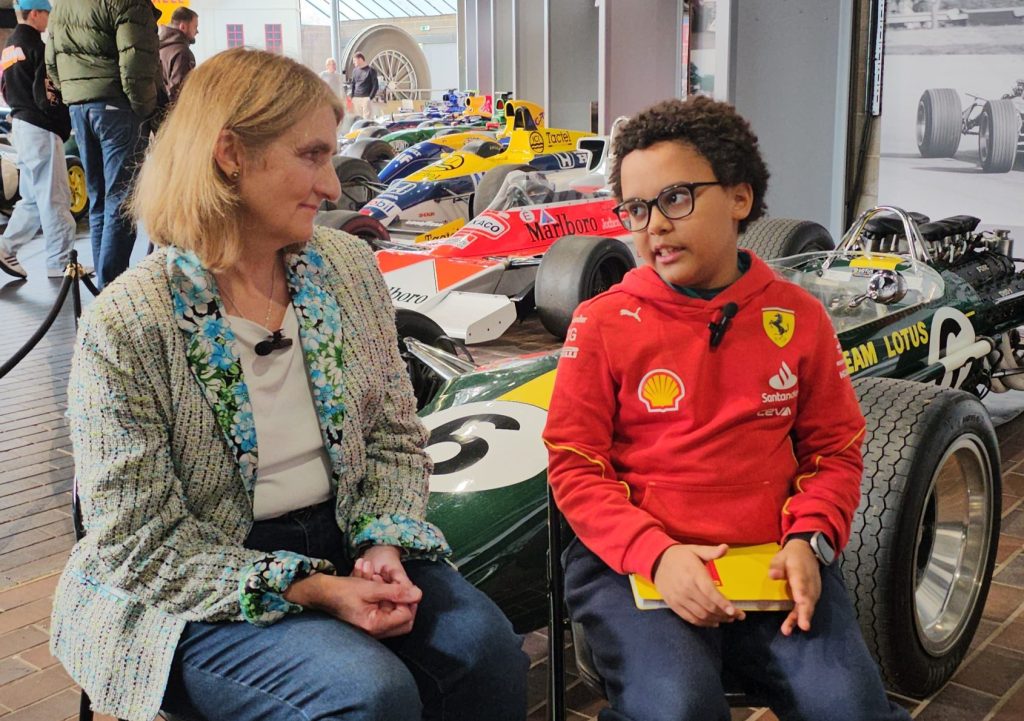
Noah was a joy to meet and left me truly inspired. If you have time do watch his interview with me, you can find it here on youtube. His questions were so evocative of my father’s time in F1. Afterwards I reflected on the technical advancements that were being made then and now.
So how does it work being at the sharp end of development and part of its technological and strategic evolution? F1 is effectively an active laboratory that millions of people watch in real time which has evolved into a forward-thinking platform for transferrable future innovation relevant to what is happening in the world.
F1 is effectively an active laboratory
The impulse to innovate and be the best led Colin Chapman to introduce the aluminium monocoque in 1967 which you see in the Lotus 49, it was revolutionary. It was the first F1 design to use a monocoque and make the engine an active part of the structure of the chassis. This resulted in a lighter, more rigid car able to transmit forces and torque more effectively.
Sid Watkins, the Prof, F1’s Chief Medical Officer who transformed safety at the circuits particularly after we lost Roland Ratzenberger, Ayrton Senna and almost Karl Wendlinger at the next race in Monaco, told me that following Ronnie Peterson’s death who sadly died from a blood clot after an accident, Colin’s impulse to innovate led him to design an anti-blood clot device, a little like an umbrella that opened up intravenously to stop the flow of blood clots.
The aluminium F1 monocoque has been replaced by composite carbon fibre monocoques, which are essentially survival cells crash tested to ensure they can withstand impacts at high speed under phenomenal G-forces, 20G is the regulation for this year’s roll hoops.
Composite carbon fibre is baked in an autoclave oven at high temperatures and under high pressure, you wouldn’t want to bake your apple pie in there!
The engine in the Lotus 49 is the famous Ford Cosworth DFV, double four valve, Ford’s first F1 engine. The DFV is one of the most successful F1 engines of all time and was built in partnership with young mavericks Keith Duckworth and Mike Costin and their British engineering firm Cosworth. My father secured the DFV’s first F1 championship title a year later in 1968.
Providing a forward-thinking platform with mutual benefit to all
I love that F1 and motorsport look up and out and the technological and strategic developments aren’t just of benefit to motorsport, they benefit many other sectors too with transformational cross-fertilisation. F1 really does pride itself on providing a forward-thinking platform for transferrable future innovation and making it ever more relevant to what is happening in the world and of mutual benefit to all.
F1’s new regulations this year are more focused on driver skill and targeted at giving fans closer and more exciting racing with their ‘nimble car’ concept, reducing the size and weight for a much more dynamic car with active aerodynamics to give very low drag on the straights and an on-demand burst of battery power for overtaking manoeuvres for closer racing.
The 2026 power unit builds on the world’s most efficient hybrid engine previously used in F1. By simplifying the power unit through the removal of the Motor Generator Heat Unit, which recovered energy from exhaust gases which of course are becoming less relevant, the PU design has been able to increase electric power by almost 300% and will also be using fully sustainable fuels, making the 2026 power unit the most road relevant yet seen in F1.
As Stefano Domenicali, CEO of Formula 1, said “The new sustainably fuelled hybrid power unit presents a huge opportunity for the global automotive industry, the drop in fuel has the potential to be used by cars around the world and dramatically cut emissions. Its potential is one of the key reasons why we will have a record number of engine suppliers in Formula 1 in 2026.”
In addition to existing manufacturers such as Ferrari, Mercedes and Honda, we will see the arrival of Audi and Red Bull Ford Powertrains, all seeing F1 as an imperative proving ground.
So how does F1 help other sectors?
And how does it apply its forward thinking to the rest of the world?
Toothpaste manufacture, London buses and supermarket fridges using aerodynamic expertise to stop cold air from seeping out, saving energy and keeping the surrounding areas warm for customers, they have all called upon F1.
Amongst the most heartfelt applications are these two that I am quoting from the Formula 1® 2025 article The 10 greatest innovations F1 has given the world: Read more at https://www.formula1.com/en/latest/article/the-10-greatest-innovations-f1-has-given-the-world.1fY8HvHkICzpj6s353iw82
Project Pitlane
When the coronavirus pandemic put the F1 calendar on pause in 2020 F1 teams were uniquely placed to respond to the crisis. Pushing their intense rivalries aside, they came together and harnessed their incredible technological capabilities and resources in the creation of a life-saving breathing device.
Aptly nicknamed Project Pitlane it involved the teams working alongside the UK government to reverse engineer existing medical devices, increase the production of ventilators efficiently and design a new device.
The process of getting approval for a medical machine would usually take two years but thanks to the relentless effort of engineers across the grid, this was completed within just four weeks, allowing an updated ventilator to be rolled out rapidly.
Paediatric Surgery
Watching F1, it’s easy to lose sight of how impressive the work of a pit stop crew actually is – tell someone who’s not a fan that four seconds is considered a slow stop and they probably wouldn’t believe you.
In 2001, two colleagues from Great Ormond Street Hospital noted the similarities between the efficiency of a pit stop and the crucial process of moving an infant after they’ve undergone heart surgery. Looking down on a stop from above, the car is in the middle and worked on by the team surrounding it, much like a baby on a trolley in a hospital.
The realisation sparked an unexpected collaboration. McLaren and Ferrari are historically two of the most intense rivals in sport, but on this occasion they joined forces to impart their knowledge and boost cardiac care for babies.
The Maranello team noticed that unlike their crews, doctors and nurses didn’t have specific roles when it came to transporting a child from the operating theatre to intensive care – if something went wrong, everyone would rush to fix it rather than leaving it to one person to fix.
Once this lesson was applied in the hospital, the number of technical errors fell by 42%, encouraging staff to recommend the procedure to hospitals across the UK.
The passion and ingenuity of F1 is ingrained in it.
These are quite phenomenal and very real on-the-ground breakthroughs, all through the passion and ingenuity of F1.
My father was investing in solar power in the 1970s. Even then he could see the way it was going with fossil fuels and the impact that they had on air quality, that they are a finite commodity and not sustainable. And so he looked to the sky, looked up and out, as was his way, and saw that the power of the sun was an alternative and more sustainable way in every sense of the word to generate power without the use of fossil fuels which we now know are a major cause of global warming impacting so undeniably the weather and oceanic systems of Planet Earth. No longer are we the perfect temperature for Goldilocks. Attached is a report he produced on the research and development of solar power.
The project Noah Cooks F1 hopes to inspire parents and young generations
And in Noah’s case it is clearly working. To quote Noah’s father Federico from the US education foundation magazine Childhood Education’s Real World Learning article on Noah, entitled Fuelling Curiosity: How Formula 1 Racing Sparked an Educational Adventure, Noah attended a Montessori preschool that “focused on cosmic education, an approach that aims to give children a unified view of the world and foster a deep sense of wonder. This holistic vision connects every element of the Universe”.
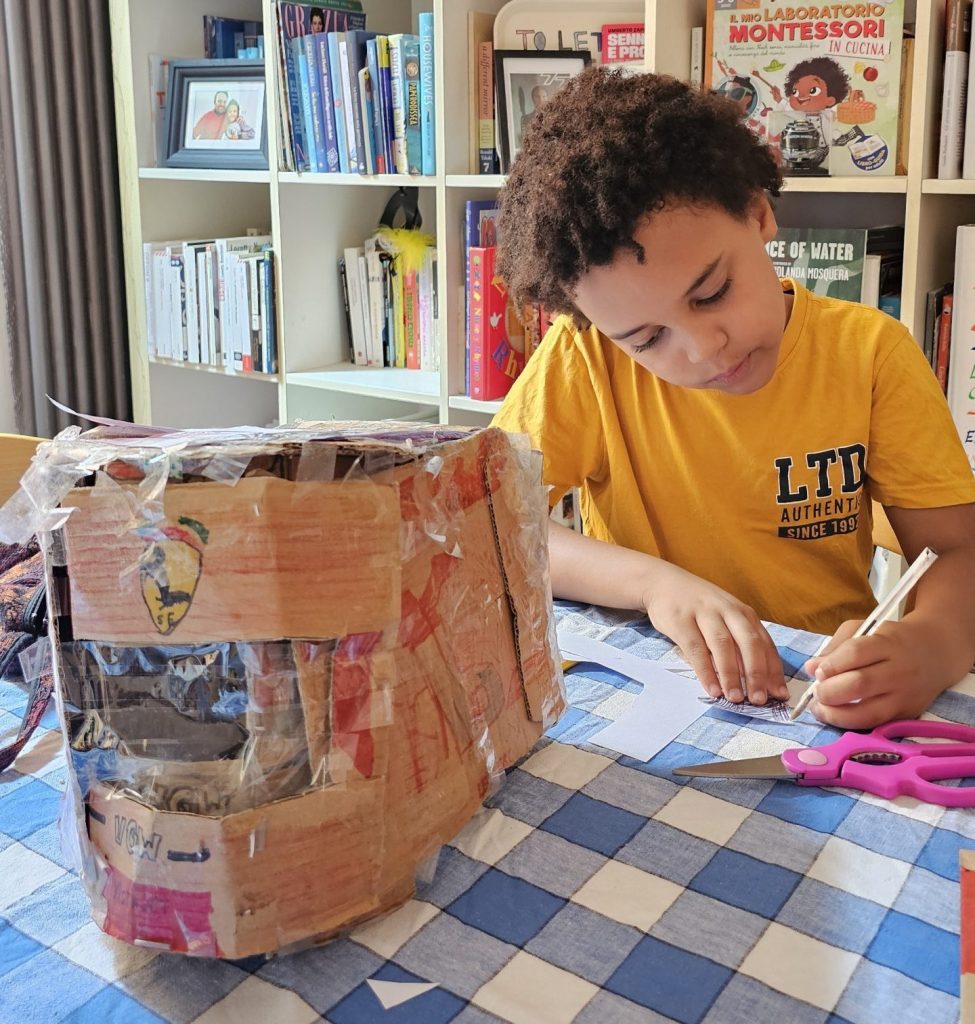
Photocredit: NoahCooksF1
Noah has been invited to attend STEM (Science, Technology, Engineering and Mathematics) in Naples.
Federico’s and Noah’s project Noah Cooks F1 hopes to inspire parents and young generations to show how it is possible for a child’s passion to help a child flourish, in Noah’s case through his passion for motorsport, enhancing his skills through his motorsport passion: Memory, design, maths, science, creativity, imagination, communication and soft skills to increase confidence by asking questions and talking to people, skills all crucial to a child flourishing in his or her own way, a way that is true to them to be who they really are and find their way in the world.
You never know, maybe one day we’ll see a hybrid F1 power unit powered by sustainable fuels, kinetic energy units harvesting solar power and fuel cells using hydrogen now being developed for many applications. Hydrogen Electrolysers won Earthshot’s inaugural 2021 prize for Fix Our Climate https://earthshotprize.org/
Now that’s a thought. Alchemy, Magic and Miracles. All making a difference and all driven by a passion for the future and all that it holds for future generations and the future of our home, Planet Earth.
NOAH BASTIANI’S NOAH COOKS F1 WITH GRAHAM HILL AND THE WORLD OF F1
By Brigitte Hill, March 2026